Can a Leased Copier Print Checks? MICR Toner Is the Easy Part
Americans write fewer checks every year, and check-fraud reports nearly doubled anyway. Here's what it takes to print a check a bank's sorter will read, why the shared copier is the wrong place to do it, and what to settle before you sign a non-cancelable lease.
Key takeaways
- U.S. check payments fell to 9.2 billion in 2024, down from 17.0 billion in 2015, while the average check grew to $2,653.[1] Fewer checks, bigger checks.
- Banks filed over 350,000 check-fraud suspicious activity reports in 2021 and over 680,000 in 2022.[4] By our math, reports per million checks paid went from about 32 in 2021 to about 74 in 2024.[1][5]
- A bank-readable MICR line is a system: magnetic toner, fuser settings, a standard font, placement and paper.[8][9] Dropping a MICR cartridge into the office copier is one piece of it.
- Settle MICR before you sign, because the lease is non-cancelable.[13] Then lock up the check stock, turn on Positive Pay, and move every vendor you can to electronic payments.[10]
Checks are dying. The ones that are left are big.
The Federal Reserve's latest payments study counted 9.2 billion check payments in 2024. That's down from 11.0 billion in 2021 and 17.0 billion in 2015. Checks are now 4% of noncash payments by number but 17% by value, and the average check climbed to $2,653, up from $945 in 2000.[1]
Read that again. There are about half as many checks as in 2015, and the average one is worth almost three times what it was in 2000. If you're a fraudster, that's a smaller menu with much bigger portions.
Even the federal government bailed. An executive order told Treasury to stop issuing paper checks for most federal payments, effective September 30, 2025.[2][3] The order's own reasoning: Treasury checks are historically "16 times more likely to be reported lost or stolen, returned undeliverable, or altered than an electronic funds transfer."[2]
But businesses that still pay by check have to print them somewhere. Which raises the question: can the leased copier down the hall do it?
Check fraud didn't get the memo
A MICR line proves a check can be read by a machine. It doesn't prove the check is yours.
Printree, on printing checks in the office
Here's the part that should bother you. In 2021, financial institutions filed over 350,000 suspicious activity reports (SARs) for potential check fraud, 23% more than in 2020. In 2022, it was over 680,000, nearly double.[4] A state bankers' association magazine, citing the Treasury's financial-crimes bureau, puts 2023 at 665,505 and 2024 at 682,276.[5]
Put the two datasets side by side and you get a number we haven't seen anyone publish:

About 32 check-fraud reports per million checks paid in 2021. About 74 in 2024. That's 2.3 times the rate in three years, on a payment method that kept shrinking. A SAR isn't a conviction, and the two counts come from different systems, so treat this as a direction, not a precise fraud rate. The direction is not great.
How the fraud actually works
When FinCEN dug into mail-theft check fraud reports filed from February to August 2023, it found 15,417 reports tied to more than $688 million in suspicious activity. Of the stolen checks, 44% were altered and deposited, 26% were used as templates to make counterfeit checks, and 20% were fraudulently signed and deposited.[6] The bankers' association summary describes fraudsters who "cook" stolen checks "using photo editing software and high-tech printers."[5]

The federal bank regulators noticed too. In June 2025 they asked the public how to fight payments fraud, "with a particular focus on check fraud."[7]
So can your copier print checks?
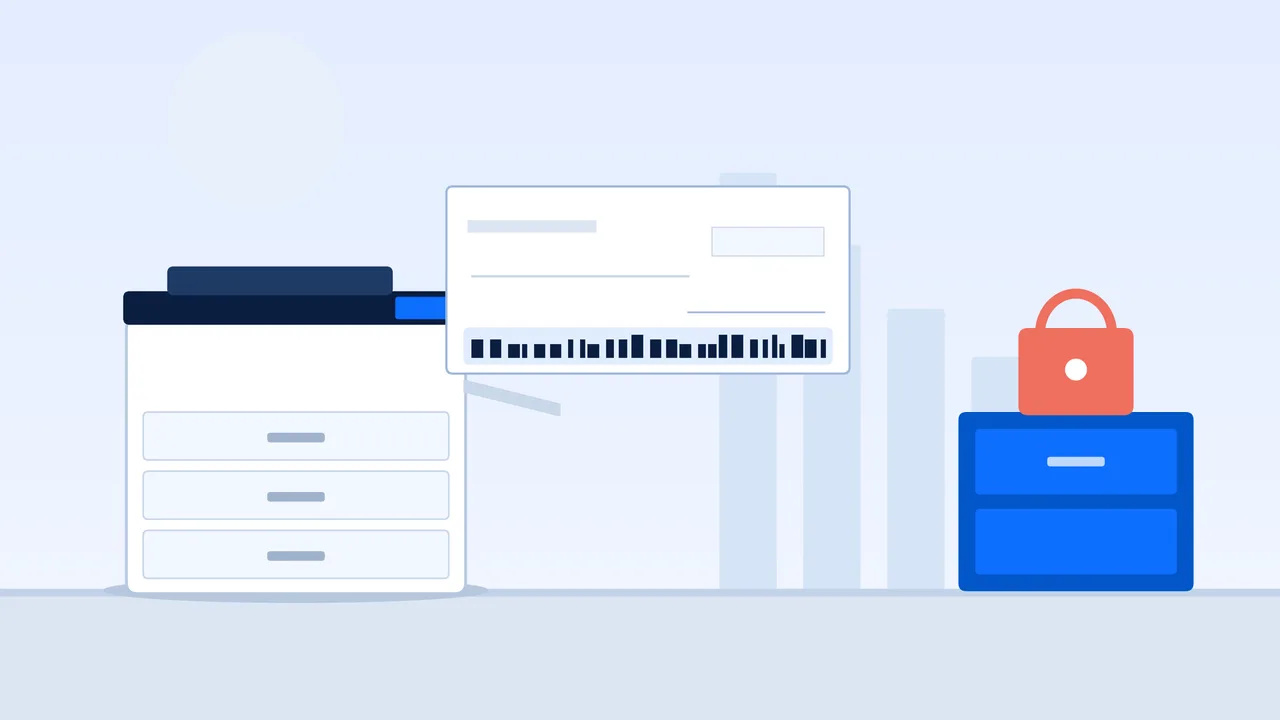
Technically, a check is just toner on paper. Practically, the strip of numbers along the bottom is the MICR line (magnetic ink character recognition), and it's what tells the bank's machines which bank the check is drawn on and which account to hit.[8]
What the standard actually asks for
The national standards that govern that line cover a lot more than "use the magnetic toner":[8]
- The font. The E-13B character set: ten numerals and four special symbols, with set shapes, dimensions and tolerances.
- The magnetic signal. The printing standard specifies the magnetic signal level of each character, plus test equipment for calibrating it.
- Placement. A separate standard covers where the MICR line sits on the document.
- Paper. Another covers the base stock, because checks have to survive automated sorting.
Why toner is only one piece
A 2002 imaging-science conference paper on laser-printed checks concluded that "with proper toner selection and fuser temperature settings, reader/sorter performance problems are minimized."[9] Toner and heat. The cartridge is half the sentence.
Our take: your copier was set up to print proposals, payroll stubs and the potluck sign-up sheet. Unless someone deliberately set it up and tested it for MICR, nobody has checked its output against a magnetic signal spec. A check that looks perfect to you can still give a bank's sorter a hard time. Before anyone prints a single check, ask three questions in writing: does the manufacturer support MICR on this exact model, with which supplies, and who verifies the output? Then ask your bank what it needs.
The lease trap nobody mentions
"Toner included" means the toner your provider supplies. MICR toner is a different consumable. Our own guidance on third-party toner in a leased copier is blunt: "If you lease from us and are thinking of using supplies you didn't get from us, ask us first."[11] We'd give that advice about anyone's lease. Find out what the agreement says about supplies you didn't buy from the provider before you load one.
The lease won't bend later. A copier lease is a non-cancelable finance agreement.[13] On Printree's published pricing of $209–$349 a month,[12] a 60-month term is $12,540–$20,940 and a 63-month term is $13,167–$21,987 ($209 or $349 times the months). If you find out in month four that the machine can't produce checks your bank accepts, you're still paying for all 60 or 63 months. Decide where checks get printed before you sign, not after. Run your own numbers in the copier lease calculator.
Page count is not the problem. A Printree lease includes 5,000 black-and-white pages a month, with overage at $0.01 a page.[12] Even if a 300-check run landed entirely in overage, that's $3. Volume isn't where check printing gets you. Security is.
The real problem is blank checks in a shared tray
The Federal Reserve's check-fraud toolkit for businesses says to keep check stock in a secure location and to "maintain security around the fulfillment process." It also recommends dual control for issuing and approving checks, limiting who can issue them, separating the people who sign checks from the people who reconcile, and daily reconciliation.[10]
Now picture blank check stock sitting in tray 3 of the copier by the break room, next to the guy reprinting his fantasy football draft. That's the opposite of a secure location.
And here's the uncomfortable bit. Every check you mail carries your routing and account numbers on the MICR line. That's the information a counterfeiter needs, and 26% of the stolen checks in FinCEN's review became counterfeit templates.[6] A MICR line proves a check can be read by a machine. It doesn't prove the check is yours.
What we'd do instead
- Ask whether you need paper at all. The Fed toolkit says to "consider alternative payment methods."[10] Every recurring vendor you move to ACH is one less check in the mail.
- Turn on Positive Pay. It's a bank service that checks each presented check against the list you issued. The Fed toolkit names it alongside account alerts.[10] Pair it with daily reconciliation.
- Keep check printing off the shared copier. Use a device set up for MICR, in a room that locks, run by the short list of people allowed to issue checks. That's our opinion, and it follows the Fed's controls above.[10]
- Lock the stock. Count blank checks in and out, and use stock with security features like microprinting and watermarks.[10]
- Mail smarter. Security envelopes, gel ink, and no outgoing checks in unmonitored mailboxes.[10]
- Get MICR answers in writing before you sign. Model support, supplies, who verifies, and what the lease says about supplies. A non-cancelable lease is a bad place to discover a "no."
If your shop is accounting-heavy, our accounting firm copier leasing page covers the rest of the setup.
Sources
- Federal Reserve, Federal Reserve Payments Study: National Payment Volumes, Top-Line Data (CY 2015-24)
- The White House, Executive Order 14247, Modernizing Payments To and From America's Bank Account (March 25, 2025)
- Bureau of the Fiscal Service, Avoid Delay: If You Still Receive a Federal Payment by Check, here are Options to Secure Your Payments (September 30, 2025)
- FinCEN, Alert on Nationwide Surge in Mail Theft-Related Check Fraud Schemes Targeting the U.S. Mail (February 27, 2023)
- Check fraud in 2026: Your questions answered (March 2026)
- FinCEN, FinCEN Issues In-Depth Analysis of Check Fraud Related to Mail Theft (September 9, 2024)
- Federal Reserve Board, FDIC and OCC, Federal bank regulatory agencies seek comment to address payments and check fraud (June 16, 2025)
- American National Standards Institute, MICR Specifications for Checks in ASC X9 Standards
- Society for Imaging Science and Technology, MICR Laser Printing and High Speed Reader/Sorter Performance (NIP18, 2002)
- Federal Reserve, Preventing Check Fraud: A Resource for Businesses
- Can You Use Third-Party Toner in a Leased Copier? The Real Cost
- Introducing the Printree Marketplace
- Copier Leasing FAQ
Frequently asked questions
Can a leased copier print checks with MICR toner?
Sometimes, but toner is only one part. Bank-readable checks need the standard E-13B font, the right magnetic signal, correct placement and suitable paper, and toner and fuser settings both affect results. Confirm model support and supplies in writing before you sign the lease.
Do checks have to be printed with magnetic ink?
Bank sorters read the MICR line magnetically, and the national printing standard specifies a magnetic signal level for each character. Ask your bank exactly what it accepts before you print your own checks.
Is MICR toner included in a copier lease's toner?
It depends on the contract, because MICR toner is a different consumable from standard toner. On a Printree lease, ask us before you use any supplies you didn't get from us.
Does MICR toner prevent check fraud?
No. The MICR line makes a check machine-readable. It also prints your routing and account numbers on every check you mail. Positive Pay, locked check stock, dual control and daily reconciliation are the fraud controls.
What's safer than printing checks in the office?
Electronic payments for recurring vendors. The Federal Reserve's business toolkit tells companies to consider alternative payment methods, and the federal government stopped issuing most paper checks on September 30, 2025.
More copier industry news
Your Copier Drowned. Your Lease Payments Didn't.
Two leased copiers drowned in 2012 hurricane flood waters, and a court still ordered $258,424.39. What the hell-or-high-water clause means and what to do first.
The "Free" Copier Upgrade Is a Loan Wearing a Party Hat
Why a mid-lease "free" copier upgrade is an old balance in disguise, with the rollover math run on our own published prices.
The $126 Million Toner Call: Why Scammers Love Your Copier
One toner scheme took $126M from 50,000+ offices, many with toner already in their copier contracts. The script, the law on the bill, and the fix.