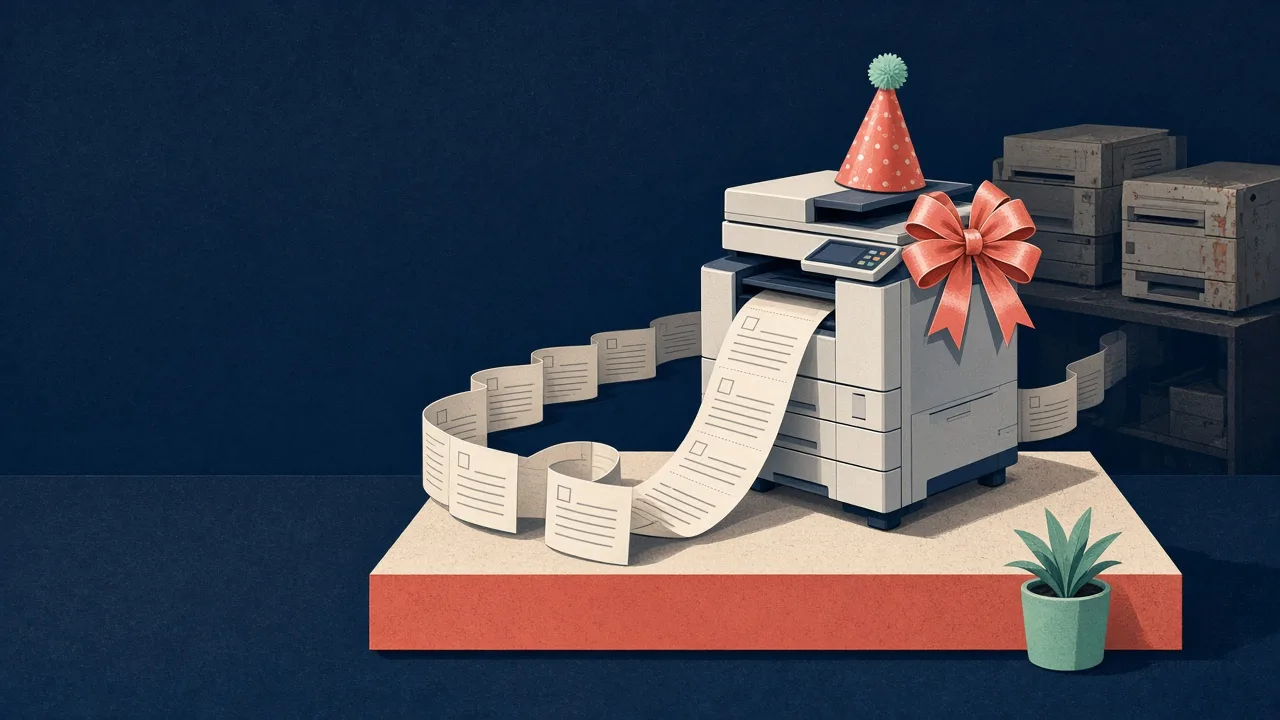
The "Free" Copier Upgrade Is a Loan Wearing a Party Hat
Dealers call it a free upgrade. Their own trade press explains why it keeps you from leaving. We read both, so you don't have to.
Key takeaways
- A mid-lease "free upgrade" can mean your remaining balance quietly rides along into a new, longer lease. Nothing gets forgiven. It gets financed.
- This isn't us being cynical. A strategy article in a dealer trade magazine told dealers that putting service inside the lease makes it "significantly more difficult for the competition to upgrade the client."[1]
- Our opinion: never accept a rollover you can't see itemized. Get the payoff in writing, broken out, before anyone says the word "free."
- Printree leases run $209–$349 a month, on terms of 36, 48, 60 or 63 months, with service and toner included. Over a 60-month term that's $12,540–$20,940. We take over payoffs too, and when we do, the payoff is added to the new agreement. We say so out loud.
The phone call you're going to get
It's month 36 of your 60-month lease. The copier works fine. Then your rep calls with good news: there's a newer model, and they'll "take care of" what you still owe.
That call doesn't come out of nowhere. A 2026 financing column for dealers spells out the timing advantage: "The dealer knows when the lease term is up and can schedule time, often in advance, to speak to their customer about upgrades."[2] You know when your lease ends too. They just put it on a calendar first.
In copier sales, "free" works a lot like "free" at a timeshare presentation. You do get the snacks. You also get a contract.
The playbook is written down, just not for you
Here's the part we think every customer should read. Few do, because it was written for dealers.
In 2022, a strategy article in a dealer trade magazine walked dealers through getting by during equipment shortages. To be fair, it's practical advice for a dealer audience during a supply crunch. It's also the most candid explanation of lease renewals we've seen in print. On renewing a customer's existing lease, it said: "This will lock the customer to you." On the buyout math: "The difference between the buyout and the amount leased would be profit because there's no additional cost." And on service: "by having it in the lease, it's significantly more difficult for the competition to upgrade the client."[1]
The same article described the upgrade habit itself as "a practice of upgrading customer equipment on a regular cycle," "in many cases, a three-year cycle." Then the kicker: it "doesn't do much for the profitability of the company," but it "does provide revenue for the manufacturer and the sales rep."[1]
Read that list again. Manufacturer, sales rep. The customer isn't on it.
The thinking hasn't gone away. That same 2026 financing column listed, as an advantage of leasing for dealers, "Predictable refresh cycles create recurring upgrade and renewal opportunities."[2] That's a perfectly normal thing to tell dealers. Our point is simple: when your lease is somebody's "opportunity," you should do your own math.
Why the incumbent's offer can look cheapest
This is the inside part nobody explains on a proposal.
When service is financed inside the lease, your payoff can include service you haven't used yet. Our read (opinion, based on how these contracts are built): a competitor buying you out has to cover that whole balance, while the dealer who already provides your service is negotiating with itself. That's exactly the advantage the trade article was describing when it said service in the lease makes it harder for "the competition to upgrade the client."[1]
So the incumbent's offer may genuinely be the lowest number on the table. That's the trick. In that setup it can be lowest because of how the exit was built, not because it's the best deal.
Honesty check: our monthly payment includes service and toner too. So ask us the same question you'd ask anyone else: what's in the payoff, line by line?
The math nobody prints on the proposal
Start with one balance. Say you still owe a hypothetical $3,500 on your current lease when the "free" offer arrives. Spread over a new 60-month term, that's $3,500 ÷ 60 = $58.33 a month, before any financing. The balance doesn't vanish. It just changes address, and it stays there for five years.
Our opinion: the earlier you say yes, the less room you have to shop. A decision made on the rep's timeline is a decision made without a competing quote.
Now do it twice. We ran the stack on our own published prices. Start with a 60-month lease at $209 or $349 a month. At month 36 you still owe 24 payments. Roll those into a fresh 60-month lease at the same price, then do it again three years later:

Here's the $209 version in plain numbers. Lease 1: 24 × $209 = $5,016 left at month 36. Spread over 60 months, that adds $83.60, so lease 2 runs $292.60 a month. At its month 36 you owe 24 × $292.60 = $7,022.40. Roll that and lease 3 runs $326.04 a month, with $7,824.96 left at month 36. At $349, the same three steps go $8,376 → $11,726.40 → $13,066.56, and the payment climbs to $544.44.
Your copier is newer each time. Your debt is bigger each time. Congratulations, you're leasing a treadmill.
Here's what that one hypothetical $3,500 balance does to a full 60-month total on our own price range:

Same machine, same term. The only difference is an old balance with a bow on it.
"But nobody's upgrading anyway"
Here's the awkward bit for the upgrade cycle. On a 2024 industry panel, one dealer executive said: "Less and less people are upgrading." His reason: "Some manufacturers have models that have been out for six or seven years," so a customer finishing a four-year lease might get refreshed "with the exact same model they already have."[3]
He added this, which we'd frame and hang in the lobby: "For us, leasing is an asset for the customer, whereas most dealers use it as an asset to keep selling new machines."[3] That's one dealer's read of his competitors, not ours. But it's a dealer saying it, in a trade magazine, on the record.
Our opinion: if the "upgrade" is the same model you already have, you're paying a rolled-in balance for a fresh meter reading.
What we'd do (opinion, clearly labeled)
- Don't decide on the rep's calendar. Ask your lessor for the payoff in writing, itemized: equipment, service, and any buyout amount, listed separately.
- Ask one question. "Is any of my current balance inside this new payment?" If the answer is yes, it isn't free. It's financed.
- Compare against a clean start on the same term. Printree's published $209–$349 a month works out to $7,524–$12,564 over 36 months, $10,032–$16,752 over 48 months, $12,540–$20,940 over 60 months, and $13,167–$21,987 over 63 months.
- Mind the clock. Our own guide says switching "usually makes sense with under 18 months remaining, and usually does not with more than 30."[5] Rolling a big balance to get a slightly newer machine is the expensive way to buy a new smell.
- Size it before you upgrade it. A newer copier won't fix a fleet that was the wrong size to begin with. Our 50-person office sizing guide walks through that, and our breakdown of copier lease types covers FMV and $1 buyout structures.
Where Printree stands
We'll be plain about our own model, because that's the whole point of this post. Printree does pay off existing leases so a business can switch, and as our own guide says, "that payoff is added to the new agreement and repaid across the term. It does not disappear."[5]
What we publish: $209–$349 a month for a full-size 45ppm color copier, with service and toner included, 5,000 black-and-white and 500 color pages a month, overage at $0.01 per black-and-white page and $0.07 per color page, and 0% annual escalation, on 36, 48, 60, or 63-month terms (source)[4]. Our lease is non-cancelable, so run the numbers before you sign, not after.
If the math says stay where you are, we'd rather tell you that than sell you a party hat. Start at printree.com.
Sources
- Mending the Supply Chain: Parts and Equipment Strategies to Maintain Profits (2022)
- The Question You Need to Answer Before You Move into Managed Services (2026)
- Dealers Discuss the Ongoing Role of Inflation in Extending Equipment Leases (2024)
- Introducing the Printree Marketplace
- How to Get Out of a Copier Lease
Frequently asked questions
Is a "free" copier upgrade really free?
Not if you still owe anything. If you still owe on your current lease, that balance can be rolled into the new one and repaid across the new term. Ask whether any current balance is inside the new payment.
What happens to my old balance if I upgrade early?
It moves. The new lease pays off the old one and spreads that amount across the new term. In our own hypothetical, a $3,500 balance spread over 60 months adds $58.33 a month before any financing, or $3,500 over the term.
What is a bundled copier lease, and why does it matter at upgrade time?
It's one lease payment covering both the equipment and service. Because the payoff can include service you haven't used yet, a competitor's buyout can look more expensive than your current dealer's upgrade. Ask for the payoff itemized.
How much does a Printree lease cost over the full term?
At the published $209–$349 a month: $7,524–$12,564 over 36 months, $10,032–$16,752 over 48 months, $12,540–$20,940 over 60 months, and $13,167–$21,987 over 63 months.
Can I cancel a Printree lease early?
No. Printree leases are non-cancelable, which is why we publish the full-term totals up front.
Keep reading
More copier industry news
Your Copier Drowned. Your Lease Payments Didn't.
Two leased copiers drowned in 2012 hurricane flood waters, and a court still ordered $258,424.39. What the hell-or-high-water clause means and what to do first.
Can a Leased Copier Print Checks? MICR Toner Is the Easy Part
Can a leased copier print checks with MICR toner? What a bank-readable check really takes, and why check fraud makes the shared copier the wrong place.
The $126 Million Toner Call: Why Scammers Love Your Copier
One toner scheme took $126M from 50,000+ offices, many with toner already in their copier contracts. The script, the law on the bill, and the fix.